Empirical Research

Crafting Dialogic Classrooms: How Wood and Code Inspire Student Voice


In today’s push toward digital technology in education, we often ask: How can technology support—not replace—student engagement, dialogue and creativity? My colleague Lene Illum and I are asking ourselves how to design for students voices and dialogue in writing practices in school. As part of our research we believe that meaningful answers lie in the intersection of the tangible and the digital. We have developed SkriveXpeditionen (The WritingXpedition) that draws on both these aspects.

SkriveXpeditionen is a didactic design developed to support creative and dialogic writing processes in Danish L1 classrooms at the intermediate level (typically grade 5) with an age group of 11-12 years. The design combines physical and digital tools to scaffold students’ narrative thinking, collaborative dialogue, and creative expression.
Skrive consists of two main elements.

First, a set of physical wooden tiles. These tiles are engraved with various narrative motifs and symbolic images. Some tiles include QR codes that link to excerpts from a shared literary starting text. The tiles function as tactile prompts that help students:

  • Generate and structure ideas
  • Decompose narrative elements
  • Visualise connections and develop plot structures

    Secondly, the open-source interactive writing tool Twine. Twine enables students to create non-linear, interactive stories, where readers make choices that affect the outcome. The platform invites computational thinking through sequencing, logic, and hypertext structure, while simultaneously encouraging literary creativity.
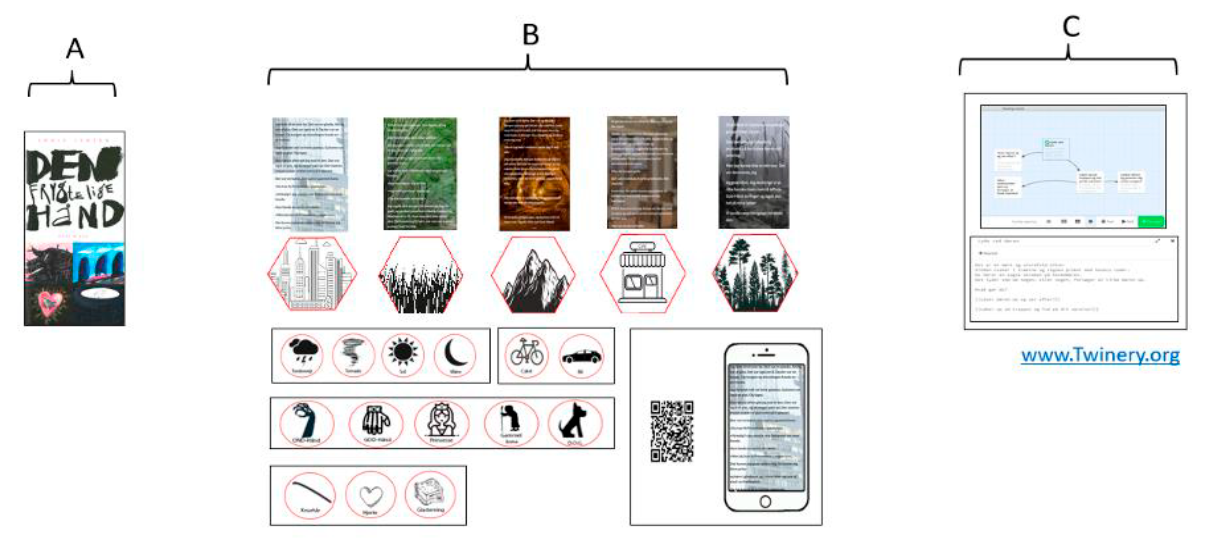
      In the image, the pedagogical design is displayed. A is the starting point where students get a short read-out-loud from the beginning of a novel. In this case, it is “The Horrible Hand”, a fantasy novel. B represents the wooden pieces and the phase where students engage and collaborate on their stories. Finally C represents the process of creating their stories in Twine.

      The Pedagogical Rationale

      SkriveXpeditionen is designed to cultivate what Neil Mercer calls exploratory talk: a form of dialogue where students collectively explore, justify, and refine ideas. The material artefacts serve as mediators that bring students’ ideas into a shared dialogic space. The goal is not only to support writing outcomes but to:

      • Enhance oral language development
      • Foster embodied and multimodal communication
      • Promote partner-awareness and collaborative meaning-making

      Learning Outcomes and Observations

      Preliminary findings from classroom interventions show that SkriveXpeditionen:

      • Strengthens students’ engagement in the writing process
      • Encourages playful experimentation and co-creation
      • Supports students in structuring stories and making narrative decisions
      • Increases participation opportunities, especially for students who might struggle with traditional writing tasks

      The design also reveals how materiality—in the form of physical tiles—can play a central role in shaping dialogic learning environments and computational literacy practices.
      SkriveXpeditionen is more than a writing tool. It is a hybrid learning design that brings together literature, technology, and embodied dialogue to support student creativity and collaboration. By combining material and digital media, it opens new pedagogical pathways for teaching writing in ways that are meaningful, imaginative, and deeply social.

      Enhancing Computational Literacy through objects to think with.

      SkriveXpeditionen is a teaching design that invites students into a creative and exploratory learning space, where storytelling and technology are tightly interwoven. Drawing on Andrea diSessa’s concept of computational literacy, learning is understood here as a materially-supported deployment of skills and dispositions toward meaningful intellectual goals.

      Unlike the narrower notion of computational thinking, often framed as a general set of problem-solving skills, computational literacy expands the view by emphasising three interrelated dimensions: the cognitive, the social, and the material. These dimensions are not separate layers but intertwined aspects of how learners engage with the world.

      SkriveXpeditionen brings all three dimensions into play. The physical wooden tiles serve as cognitive scaffolds, allowing students to break down and recompose narrative ideas. Group work and conversation create a shared space where meaning is socially negotiated. At the same time, both the tiles and the Twine platform act as material mediators, giving shape to students’ abstract thinking and enabling new forms of interaction and expression.

      In this interplay, students do not merely write stories—they engage in thinking through materials. They work with narrative elements, symbols, and code to construct meaning within a shared ecology of learning. It is precisely within this process that what Seymour Papert called powerful ideas begin to emerge.

      Students learn how ideas evolve in collaboration and dialogue, as they articulate and refine their thinking through shared language, gesture, and embodied interaction. They work with narrative systems, grappling with cause-effect relationships, branching logic, and interactive structures—not as abstract concepts, but through concrete storytelling practices. They also explore how representational elements can be rearranged and transformed, discovering that story components are not fixed but fluid and malleable.

      SkriveXpeditionen is not about teaching programming per se. Instead, it aligns with Papert’s deeper pedagogical vision of using technology as a medium for expression, a tool for exploration, and a mirror for thinking.

      We will continue our research and development

      Lene and I will continue our endeavour into SkriveXpeditionen and how to enhance and develop the design. Next steps for us is to focus on a more generic concept that can be applied to a vararity of texts in L1.

      Stay tuned!

      Empirical Research

      Rethinking Computational Thinking in Education

      Computational thinking (CT) has become a buzzword in educational policy and curriculum reform. Promoted as a fundamental 21st-century skill, it is often described as a universal way of thinking—akin to literacy and numeracy. But beneath this seemingly neutral framing lies a deeper question: What kind of thinking do we want students to engage in, and what role should schools play in nurturing it?

      The current dominant view of CT, popularised by Jeannette Wing, sees it as a set of abstract, transferable skills drawn from computer science—algorithmic thinking, abstraction, problem decomposition. This approach fits neatly into existing curricular structures and assessment regimes, but it risks sidelining the messier, more situated, and culturally embedded dimensions of learning with and through computers.

      An alternative perspective comes from Seymour Papert, whose work in the 1970s and 80s laid the groundwork for what we now call CT. Papert didn’t frame CT as a fixed set of skills. Instead, he was concerned with thinking deeply about thinking itself—learning through making, experimenting, and expressing ideas in computational media. His approach, known as constructionism, was grounded in the idea that children learn best when they are actively engaged in building things that are meaningful to them.

      Ai generated image in ChatGPT displaying three themes Papert's development of constructionism. The Tutle Program, Soap Sculptures and Samba Schools.

      Ai generated image in ChatGPT displaying three themes Papert’s development of constructionism. The Tutle Program, Soap Sculptures and Samba Schools.

      Our educational system rejects the “false theories” of children, thereby rejecting the way children really learn. (Papert, Mindstorms 1980)

      Central to Papert’s vision were what he called “objects-to-think-with”—tangible or digital artefacts that serve as tools for thought. These could be programmable turtles on the screen, floor robots, or soap sculptures. The key is that learners engage with these objects not through instruction, but through exploration and iteration. The act of programming becomes a medium for expressing ideas, testing hypotheses, and developing personal and shared understandings.

      Papert’s notion of epistemological pluralism is equally crucial. He recognised that learners approach problems in different ways—some prefer planning and abstraction, others tinker and iterate. Both styles are valid, and a healthy learning environment supports this diversity. In contrast, much of today’s CT implementation privileges the abstract, logical, and formal, often marginalising intuitive, creative, or sensory approaches to computational problem-solving.

      Another critical insight from Papert is his view of schools as cultural institutions with deeply ingrained norms. He was sceptical of how technologies—computers included—tend to be absorbed into existing school structures rather than transforming them. He warned against what he called technocentrism—the belief that technological tools alone can drive educational change. For Papert, the real power of the computer lay not in the machine itself, but in its potential to disrupt traditional pedagogies and empower learners.

      Little by little the subversive features of the computer were eroded away: Instead of cutting across and so challenging the very idea of subject boundaries, the computer now defined a new subject; instead of changing the emphasis from impersonal curriculum to excited live exploration by students, the computer was now used to reinforce School’s ways. What had started as a subversive instrument of change was neutralized by the system and converted into an instrument of consolidation (Papert, The Children’s Machine, 1993)

      Papert’s vision of a “Samba School for Computing” offers a compelling metaphor. Inspired by the inclusive, community-based learning culture of Brazilian samba schools, he imagined computational learning as a pluralistic, joyful, and participatory activity. Instead of rigid curricula and standardised assessment, imagine spaces where children and adults collaboratively explore, build, play, and perform with computational media—learning not just to code, but to express, critique, and co-create.

      This vision remains deeply relevant today. While CT is often justified by its economic utility—preparing students for future jobs—Papert reminds us that schools should not merely serve existing societal needs. They should be spaces for reimagining society itself. Rather than training students to think like computer scientists, we might ask how computation can support them in thinking like designers, storytellers, activists, or citizens.

      Moreover, Papert’s critique of the school’s “immune system”—its tendency to neutralise radical ideas—is as pertinent as ever. Today’s digital tools are often used to reinforce traditional instruction rather than to reimagine it. Many implementations of CT end up focusing on tool mastery rather than tool invention, reinforcing rather than disrupting existing power structures in education.

      A genuinely transformative approach to CT would begin not with abstract definitions but with concrete engagements: what are learners passionate about? What problems do they want to solve? What stories do they want to tell? From there, educators can scaffold experiences that build computational fluency in ways that are meaningful and contextually grounded.

      Key Takeaways for Schools Today:

      1. Reframe CT as situated practice Rather than treating computational thinking as a decontextualised skill set, we should design learning environments that situate CT in meaningful, hands-on, and culturally relevant practices.
      2. Value epistemological diversity Support different ways of knowing and thinking. Not all students thrive through abstraction—some learn best through tinkering, storytelling, or physical interaction with materials. All of these are valid pathways into computational understanding.
      3. Challenge the school’s “immune system” Schools must remain open to educational models that challenge the status quo. CT has the potential to democratise and humanise learning—if we resist the urge to reduce it to testable outcomes and instead embrace it as a medium for expression, reflection, and cultural participation.

      Empirical Research

      Assessing Computational Literacy in First Language (L1) Teaching

      New article out in Nordic Journal of Comparative and International Education.

      Computational Thinking should be rejected as a generic set of skills that can be applied and transferred to fit all subjects. Computational Thinking should rather be seen as context-dependent and integrated into the specific subject’s existing methods and traditions. In other words, instead of pushing a computer science template onto an existing subject, more consideration should be given to aligning computational approaches with the specific subject.

      Proud to share a new article on Assessing Computational Literacy in First Language (L1) Teaching by Marie Falkesgaard Slot and I.
      In the article, we propose a cross-disciplinary framework to assess computational literacy (CL) in L1 settings, focusing on four principles that bridge traditional language arts with computational approaches.
      We further reflect on how applying these principles can help formulate new learning goals that better align with the emerging demands of 21st-century education. Throughout the article, we argue that a CL approach provides a more socially rooted and context-sensitive method for integrating computational methods into non-computer science subjects, offering theoretical clarity and practical benefits for both educators and researchers alike. The article commences with a discussion of the CL approach related to assessment.