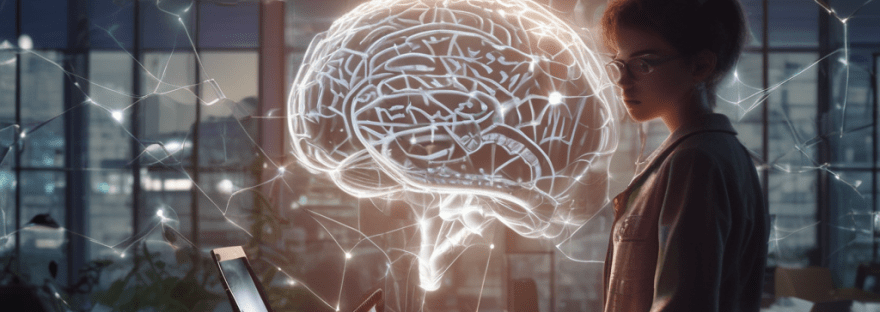
In today’s world, Artificial Intelligence (AI) is not just for tech experts—it’s something we’re all interacting with more and more, sometimes without even realizing it. From apps that help you learn a new language to smart systems that assist in your workplace, AI is everywhere. But how exactly does AI change the way we learn throughout our lives? When reading through research and books I found that I could the literature AI into three main ideas. Let’s take a quick tour of these ideas!
Idea 1. AI for Efficiency: Making Learning Faster And More Efficient
The first idea focuses on how AI can make learning more efficient. Imagine having a personal tutor available 24/7, helping you practice new skills or understand difficult concepts. AI systems like these are designed to step in where humans might be limited by time or resources. They’re especially common in workplaces, where they help employees learn new skills quickly to keep up with changes in technology. The downside? These AI tools often treat learning as something mechanical—focused on getting the right answers or completing tasks as quickly as possible, without much room for creativity or deep thinking.
Key Point: AI can help us learn faster, but it might miss the bigger picture of what learning is really about.
Idea 2. AI as A Virtual Assistant: Learning With AI, Not Just From It
The second idea highlights AI as more of a partner or assistant. Instead of just spitting out answers, AI systems work alongside humans, offering feedback and suggestions as we learn together. “Coboting” could be a term for that. For example, AI might act as a language assistant, helping you practice speaking by responding to your sentences in real-time. This approach recognizes that learning isn’t just about getting the correct answers—it’s about the process, the environment, and the relationships involved.
Key Point: AI can be a learning buddy, making the process more interactive and engaging.
Idea 3. AI As An Impulse For Change: Changing How We Learn Altogether
The third, and most futuristic idea, sees AI as a force that could completely change how we think about learning. Here, AI isn’t just a tool or a partner—it’s part of a broader shift in how we live and work. This might mean that AI is reshaping the roles humans play in the workplace or even in our personal lives. For instance, an AI might not just help you learn a language but might be part of a new way of communicating entirely, blurring the lines between technology and humanity.
Key Point: AI could lead to entirely new ways of learning, pushing us to rethink our roles in the world.
Wrapping It Up
AI is reshaping the idea of lifelong learning – from speeding up the learning process to transforming it altogether. Whether AI is acting as a tool, an assistant, or a revolutionary force, it’s clear that the future of institutionalized learning is going to look very different from what we’re used to. And while these changes offer possibilities, they also challenge us to think critically about what it means to learn in a world where AI has become an agent. Do we want AI in school – and if so, how do we want it to shape the way we work?
A recent study gives a nice review of the current research within the above mentioned areas. For further reading: Palenski, T., Hills, L., Unnikrishnan, S. et al. How AI Works: Reconfiguring Lifelong Learning. Postdigit Sci Educ (2024). https://doi.org/10.1007/s42438-024-00496-y
 Roland Hachmann