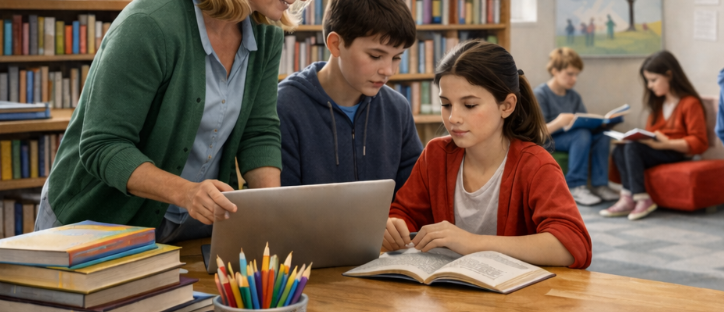
Over recent decades, the school library in many schools has been reorganised into a Pedagogical Learning Centre (PLC) with a strong focus on learning resources, guidance and school development. We are now seeing a shift back, where the school library is re-emerging as a central pedagogical function—not in opposition to the PLC, but as a revitalised framework that brings reading, Bildung and guidance together in a clearer organisational form.
Across the Nordic countries, school libraries have already been significantly strengthened through legislation and national initiatives. These experiences are important to consider as Denmark once again discusses what the school library of the future should be. This article reflects on what a revitalised school library must be able to do, the role it can play in school development and guidance structures, and why there is an urgent need for updated knowledge about the current state of Danish school libraries.
When legislation and strategy strengthen the school library
– Experiences from Sweden and Norway
In Sweden, the school library has been gradually strengthened through both legislation and national initiatives. As early as 2010, the Education Act required schools to provide pupils with access to a school library. In 2024, the Swedish parliament adopted further amendments specifying that all pupils from preschool class to upper secondary education must, as a general rule, have access to a staffed school library located at their own school. The explicit purpose of the school library is to support pupils’ learning and reading across subjects. These changes took effect in July 2025.
The background for this political prioritisation is a widely debated “reading crisis” among children and young people in Sweden. In response, the government has invested substantial resources in printed books and school libraries as a way to counter declining reading skills and increasing screen use. The school library is thus positioned as a key part of the solution.
In Norway, pupils are likewise entitled to access a school library in both compulsory and upper secondary education. This has, for several years, been accompanied by a national programme for school library development, where the state has funded development projects, professional development initiatives and digital resources focusing on information literacy and reading instruction. In Norway’s national library strategy (2020–2023), the school library is described as a space for democracy, Bildung, reading motivation and information competence, with an explicit mandate to support teaching.
Importantly, Norwegian policymakers have also called for better data on how school libraries actually function in practice. This has led to systematic data collection by the Directorate for Education and Training. The Norwegian case thus illustrates that strengthening school libraries is not only a matter of political intention and formal frameworks, but also of generating knowledge about everyday practice.
More than a room with books
Seen in the light of Swedish and Norwegian experiences, it becomes clear that a modern Danish school library is far more than a physical space containing books. It is a pedagogical function that must be clearly defined and organisationally anchored.
When discussions arise about “replacing the PLC with the school library”, this should not be understood as a mere change of terminology. Rather, it points to a reorganisation of the school’s shared resources. What a revitalised school library should look like in a Danish context cannot be defined in a single model, but at minimum it could include:
- Reading and literature didactics Curating fiction and non-fiction and developing teaching activities that strengthen both reading skills and reading pleasure across subjects—drawing on Nordic experiences where school libraries are explicitly linked to pupils’ reading development.
- Information and media literacy Supporting pupils’ work with sources, information seeking and digital texts, inspired by Norwegian initiatives on information literacy. This may also include guidance on the use of the school’s broader learning resources.
- Culture and democracy Creating spaces for dialogue about diversity, critical literacy and democratic participation, as highlighted in Swedish research on school libraries working with critical literacy and democratic Bildung.
Such ambitions presuppose qualified staff and time for collaboration with teacher teams and guidance functions. Swedish experience in particular shows that legal requirements only make a real difference when staffing and professional competence are prioritised—not merely shelf space.
The School library as a local driver
A current Danish example where the school library could play a central role is the national læselyst.nu [Reading Joy Now] initiative, which runs over the next ten years intends to strengthen children’s and young people’s motivation to read.
Here, the school library is an obvious site for local anchoring. National reading initiatives risk becoming short-lived campaigns if they are limited to materials, websites and isolated events. When connected to a strong institutional function such as the school library, they can instead develop into sustained practice.
The læselyst.nu initiative also follows the national book funding scheme administered by the CFUs. Again, this mirrors experiences from Norway, where state-funded book provision to school libraries has explicitly aimed to strengthen reading engagement, and from Sweden, where large-scale investments in printed books and school libraries form a core response to the reading crisis.
For Danish schools, this suggests that læselyst.nu could be meaningfully linked to:
- local reading initiatives based in the school library,
- systematic use of the school library in Danish and across subjects,
- collaboration between the school library, reading specialists and teacher teams—both in supporting pupils with reading difficulties and in challenging strong readers.
The school library in collaboration with guidance functions
Many Danish schools already have strong guidance structures in place: reading specialists, learning consultants and subject-based resource persons. Research and practice suggest that these functions have the greatest impact when connected to an active and clearly defined school library.
Rather than functioning as an isolated unit, the school library should be integrated into the school’s overall guidance and development work. Reading specialists can contribute expertise on assessment data and reading difficulties; learning consultants can support strategic work with learning resources and school development; and school librarians can animate reading communities and provide concrete support for teachers’ choice of texts, genres and materials.
When these functions work together, stronger coherence emerges between guidance, teaching and pupils’ everyday experiences. The school library becomes a shared point of reference where professional knowledge and practice are brought together.
A lack of knowledge about Danish school libraries
Reintroducing and strengthening the school library has the potential to support professional learning communities and anchor development initiatives related to reading culture, interdisciplinary teaching, multimodal production and coherent learning resource strategies.
However, this requires clarity: Who is responsible for what? What resources are available? How is the school library organisationally anchored to ensure it becomes a genuine pedagogical hub rather than a symbolic label?
At present, Denmark lacks a comprehensive and up-to-date picture of how school libraries are organised and used in practice. Experiences from Norway and Sweden show that systematic mapping of staffing, competencies and collaboration patterns is crucial if school libraries are to be strengthened on an informed basis.
If the school library is to continue to have a central role in the Danish school system, it is therefore not enough to revive the term itself. What is needed is a clear task description, qualified staff, time for collaboration and a systematic focus on what actually works in practice. Here, Denmark can learn from its Nordic neighbours while developing a distinctly Danish model for the school library of the future: a place that supports reading and learning motivation, strengthens professional practice and contributes actively to the school’s broader educational mission.
 Roland Hachmann