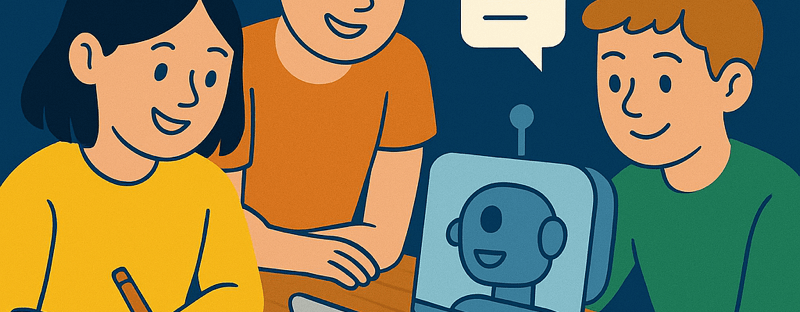
As generative artificial intelligence (GAI) rapidly makes its way into classrooms, discussions about its educational implications tend to oscillate between promise and peril. In our recent article published in Unge Pædagoger ( https://u-p.dk/vare/2025-nr-2/ ), Peter Holmboe and I explore how GAI might become a tool not of automation, but of amplification — nurturing rather than replacing students’ creative engagement with the world.
At the heart of our argument is the idea that creativity is not a spontaneous spark or a gift bestowed on a few, but a socially and materially situated process that thrives on exploration, reflection, and dialogue. GAI, when used with care, can become a medium for such engagement — but only if educators retain a clear focus on human agency, intentionality, and context.
From Prompt to Product: A Framework for Creative AI Integration
To support this reframing, we propose a practical teaching model based on three focal points: prompt, process, and product. Each stage reflects different opportunities for teacher intervention and student engagement:
- Prompts are not mere instructions to the machine; they are invitations to think differently, to explore multiple meanings, and to frame the problem creatively.
- Processes involve iteration, dialogue, and experimentation — often where the real learning and growth happens.
- Products, whether a story, a song, or a prototype, become less about perfection and more about reflection: what did we learn by making this?
This model is enriched by three complementary methods: immersion, tinkering, and disruption. Each represents a way for students to work with GAI in ways that retain ownership of the learning process.
- Immersion promotes deep, focused work within well-defined boundaries.
- Tinkering supports playful experimentation, where learning happens through trial, error, and surprise.
- Disruption challenges habits and assumptions, using constraints or provocations to push thinking in new directions.
Creativity is Situated — and So is AI
We argue that creativity does not exist in a vacuum. Following Schön, Tanggaard, and Vygotsky, we locate creative thinking in the embodied, social, and material world. This is where human intelligence diverges most significantly from GAI: AI may generate content, but it cannot inhabit context. It predicts plausible output; it does not understand meaning. This has implications for how we teach with GAI. If students merely outsource creative tasks to a machine, we risk losing what matters most: their voice, their struggle, their growth. However, if we invite them to collaborate with GAI — to question it, repurpose it, and respond to it — then the technology becomes a stimulus, not a substitute.
Toward a Pedagogy of Possibility
Teaching with GAI calls for what we term didactic imagination: a combination of foresight, courage, and responsiveness. It means being willing to reshape curricula, adapt practices, and imagine new learning trajectories — not because we surrender to technological determinism, but because we remain committed to meaningful, learner-centered education. The notion of didactic imagination, teaching with generative artificial intelligence (GAI) is not merely a matter of integrating a new tool into the classroom — it represents a profound shift in how we conceive of pedagogy, knowledge, and student engagement. Didactic imagination challenges educators to go beyond reactive adaptation and instead engage in proactive rethinking of educational practice. It is a stance that requires:
- Foresight to anticipate how GAI may shape future forms of knowledge production, communication, and creativity — and to prepare students not just to use tools, but to question and redefine them.
- Courage to depart from familiar routines, assessment models, and linear instructional design in favour of more open-ended, exploratory, and student-driven approaches.
- Responsiveness to the evolving needs, interests, and capacities of students in a rapidly changing world — acknowledging that meaningful learning emerges in the dynamic interplay between structure and spontaneity, between teacher intention and student agency.
Didactic imagination implies treating curricula not as fixed templates, but as living frameworks that must be continually reinterpreted in light of new possibilities. This may mean designing activities where students co-develop prompts with GAI, reflect critically on algorithmic bias, or remix AI-generated content in ways that foreground their own perspectives. It may mean disrupting traditional roles of teacher and student, where the teacher becomes a co-inquirer, and the classroom becomes a lab for collective sense-making.
Importantly, embracing didactic imagination does not mean abandoning rigour or coherence. Rather, it calls on us to re-anchor educational practice in the core values of curiosity, empathy, agency, and dialogue. In this view, GAI becomes a provocateur — a reflective partner that invites new ways of asking questions, framing problems, and expressing understanding.
Thus, the real innovation lies not in the machine, but in how we choose to imagine and inhabit the pedagogical spaces it opens. The challenge for educators is to hold open these spaces — not for efficiency, but for exploration. Not to automate learning, but to animate it.
Concluding thoughts
In light of this, I invite colleagues across sectors and disciplines to pause and reflect — not merely on how generative AI (GAI) fits into current pedagogical structures, but on how it compels us to rethink some of the fundamental principles of education itself. The integration of GAI challenges us to reconsider what it means to learn, to create, and to be an agent in the process of knowledge-building.
What does student agency mean in an era of generative AI?
When machines can generate text, images, code, and even ideas with remarkable fluency, the concept of student agency cannot be reduced to mere task completion or content production. Agency must be reframed as the capacity to make meaningful decisions within complex, sociotechnical environments — to pose original questions, to shape technological tools for personal or communal ends, and to navigate ambiguity with intentionality. It’s about giving students the authority and responsibility to direct their learning journeys — not in isolation, but in active dialogue with intelligent systems. In this view, agency becomes not just the right to act, but the ability to critically reflect on how and why we act in partnership with AI.
How can we design learning experiences where GAI is used to provoke, not predetermine, creativity?
Too often, educational technology has been employed to automate or simplify learning, reducing complexity instead of engaging with it. But GAI opens new possibilities: it can serve as a creative irritant, a tool for playful experimentation, or a mirror that reflects and reframes student thinking. Learning designs that foreground iteration, co-construction, and reflection — rather than fixed outcomes — are essential. Imagine prompts that ask students to revise or challenge an AI-generated poem, or collaborative projects where students must make the logic behind AI decisions visible and debatable. In these scenarios, creativity is not something AI delivers — it is something students practice and develop through interaction with AI.
How do we assess creative work when the process involves both human and machine actors?
Traditional assessment models — focused on individual output, originality, and correctness — are poorly suited to hybrid creative processes. We need evaluative frameworks that can account for process, intention, and transformation. This includes assessing how students shape AI contributions, how they reflect on ethical and contextual implications, and how they position themselves as co-authors of meaning. Rubrics may include dimensions like critical decision-making, iterative development, or responsiveness to feedback. Importantly, assessment must shift from product-focused grading to process-aware evaluation — making visible the learning embedded in the co-creation journey.
Can disruption — not just fluency — become a valued competence in our AI-enhanced classrooms?
Fluency in AI tools is important, but fluency alone risks producing compliance rather than creativity. We must also value disruption — the ability to interrupt routines, challenge defaults, and see beyond the surface of algorithmic convenience. This includes introducing ‘productive friction’ into learning environments: constraints that force rethinking, prompts that provoke surprise, and design challenges that resist easy automation. By cultivating the capacity to critique and complicate technology, we nurture students who don’t just use AI, but who actively shape its cultural, ethical, and creative trajectories.
 Roland Hachmann
1 thought on “Teaching with AI: Creativity, Student Agency, and the Role of Didactic Imagination”