
New article out in Nordic Journal of Comparative and International Education.
Computational Thinking should be rejected as a generic set of skills that can be applied and transferred to fit all subjects. Computational Thinking should rather be seen as context-dependent and integrated into the specific subject’s existing methods and traditions. In other words, instead of pushing a computer science template onto an existing subject, more consideration should be given to aligning computational approaches with the specific subject.
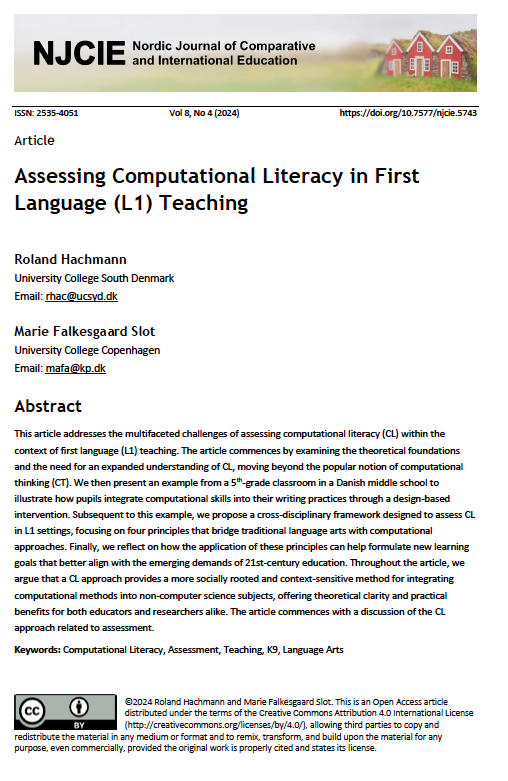
Proud to share a new article on Assessing Computational Literacy in First Language (L1) Teaching by Marie Falkesgaard Slot and I.
In the article, we propose a cross-disciplinary framework to assess computational literacy (CL) in L1 settings, focusing on four principles that bridge traditional language arts with computational approaches.
We further reflect on how applying these principles can help formulate new learning goals that better align with the emerging demands of 21st-century education. Throughout the article, we argue that a CL approach provides a more socially rooted and context-sensitive method for integrating computational methods into non-computer science subjects, offering theoretical clarity and practical benefits for both educators and researchers alike. The article commences with a discussion of the CL approach related to assessment.
 Roland Hachmann